
The Programming Logic Behind Nintendo Scribblenauts: Deconstructing a “Plain English” Domain-Specific Language
Nintendo Scribblenauts represents one of the most ambitious attempts in game development to bridge natural language input with interactive visual output. Your characterization of it as a “plain English” opinionated Domain-Specific Language (DSL) is remarkably accurate, though the underlying implementation reveals fascinating constraints and creative solutions that make it even more impressive than it initially appears.
The Conceptual Foundation: Scribblenauts as a DSL
Scribblenauts functions as an external DSL specifically designed for the domain of interactive object creation and puzzle-solving. Unlike traditional programming languages, it accepts natural language nouns and adjectives as valid syntax, then interprets these inputs to instantiate interactive game objects with appropriate behaviors and properties12.
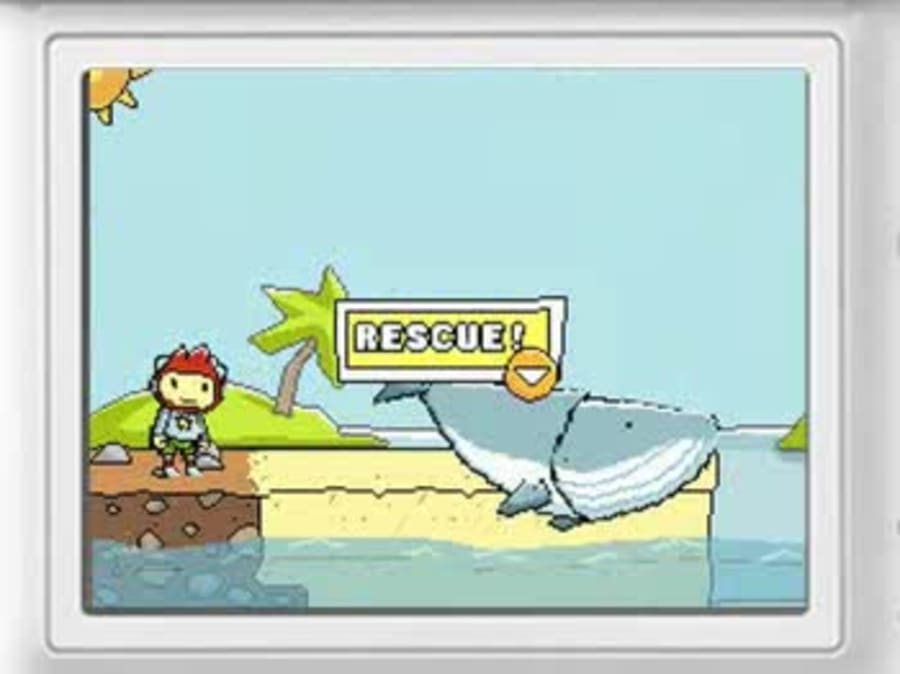
Scribblenauts gameplay interface showing the main character and an interactive command prompt to rescue a whale.
The game’s DSL design philosophy centers on declarative programming - players declare what they want (“fire truck”, “flying cat”, “giant sword”) rather than describing how to create it. This abstraction layer hides the complex underlying object instantiation, physics application, and behavior assignment processes1.
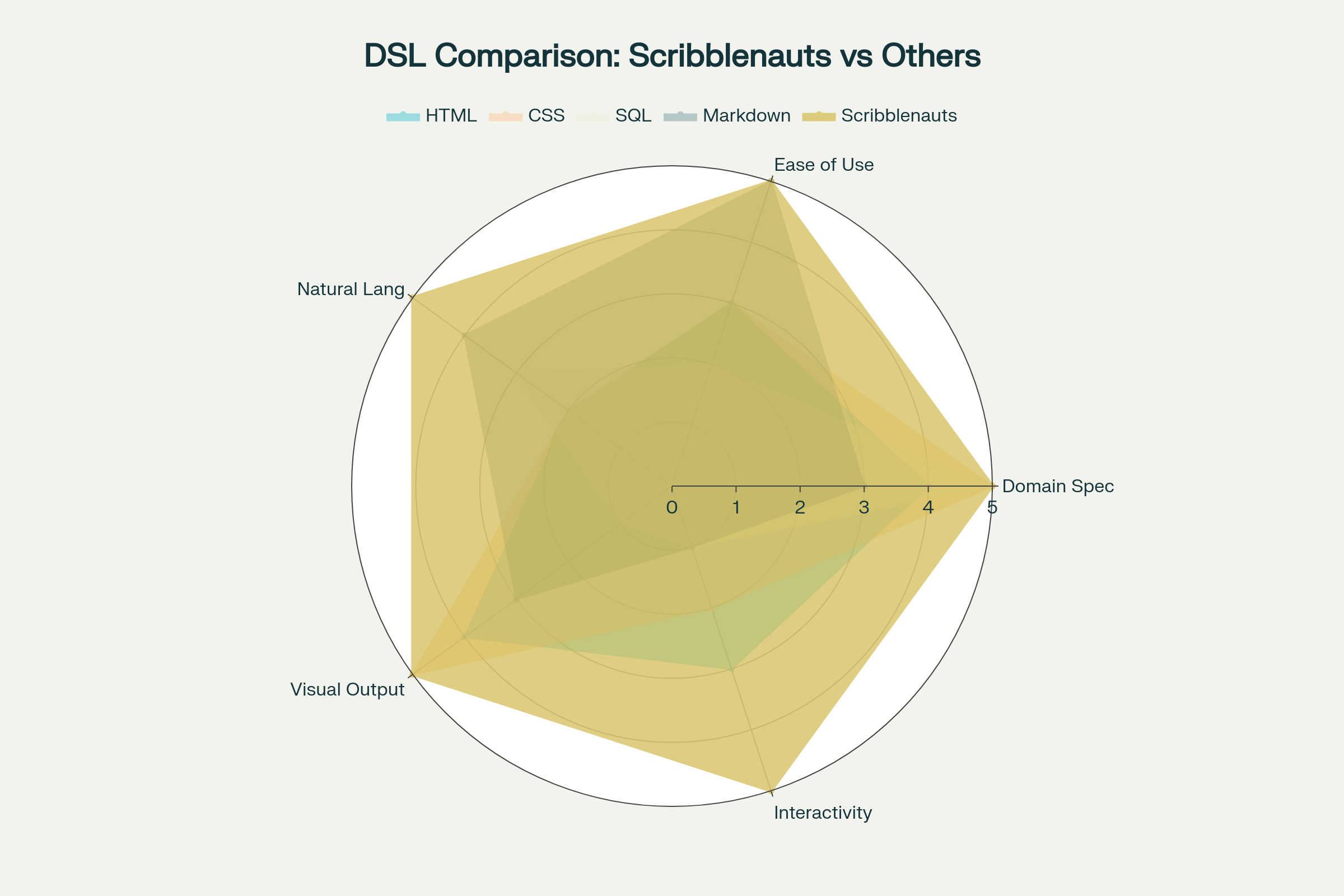
Scribblenauts Compared to Other Domain Specific Languages
Technical Architecture: The Objectnaut Engine
The heart of Scribblenauts’ DSL implementation lies in the Objectnaut engine, created by 5th Cell’s technical director Marius Fahlbusch34. This custom engine represents a sophisticated data-driven architecture that challenges common assumptions about how such systems work.
The Reality Behind the Magic
Contrary to popular belief, Scribblenauts does not use procedural generation or complex inheritance systems. Former 5th Cell designer Liz England revealed that objects were “hand authored 1 by 1” rather than automatically generated through algorithmic systems5. This represents what she termed “mathwashing” - the misconception that the system relies on sophisticated algorithms when the reality involves extensive manual curation.
The development process involved five people spending six months manually researching and cataloging words from dictionaries, encyclopedias, and Wikipedia6. This painstaking process created a database of approximately 10,000-20,000+ objects in the original game, with Super Scribblenauts adding over 10,000 adjectives7.
Object Data Structure and Flag System
Each object in Scribblenauts follows a structured template that can be conceptualized as:
struct ObjectTemplate {
    u16 ObjectID;          // Unique identifier
    const char* Name;      // Primary name and aliases
    u32 Flags;             // Bitmask properties
    u16 SpriteID;          // Visual representation
    u16 PaletteID;         // Color scheme
    PhysicsParams Physics; // Mass, friction, bounce
    BehaviorFunc* AI;      // Behavior functions
    SoundFX* Sounds;       // Audio effects
};
The flag-based interaction system forms the core of Scribblenauts’ “opinionated” DSL semantics. Every object interaction boils down to bitmask flag checks8. For example:
- Fire + Flammable objects → Combustion
- Water + Fire → Extinguishing
- Predator flags + Prey flags → Chase behavior
Hierarchical Property Inheritance
While objects were hand-crafted, the system does employ hierarchical categorization for efficiency. Objects inherit properties from parent categories - all mammals share basic mammalian traits, but specific exceptions can be manually coded (elephants fear mice, despite being much larger)9.
Scribblenauts Object Inheritance Hierarchy
Hardware Constraints and Design Decisions
The Nintendo DS’s severe hardware limitations fundamentally shaped Scribblenauts’ architecture and reinforced its DSL-like simplicity10.
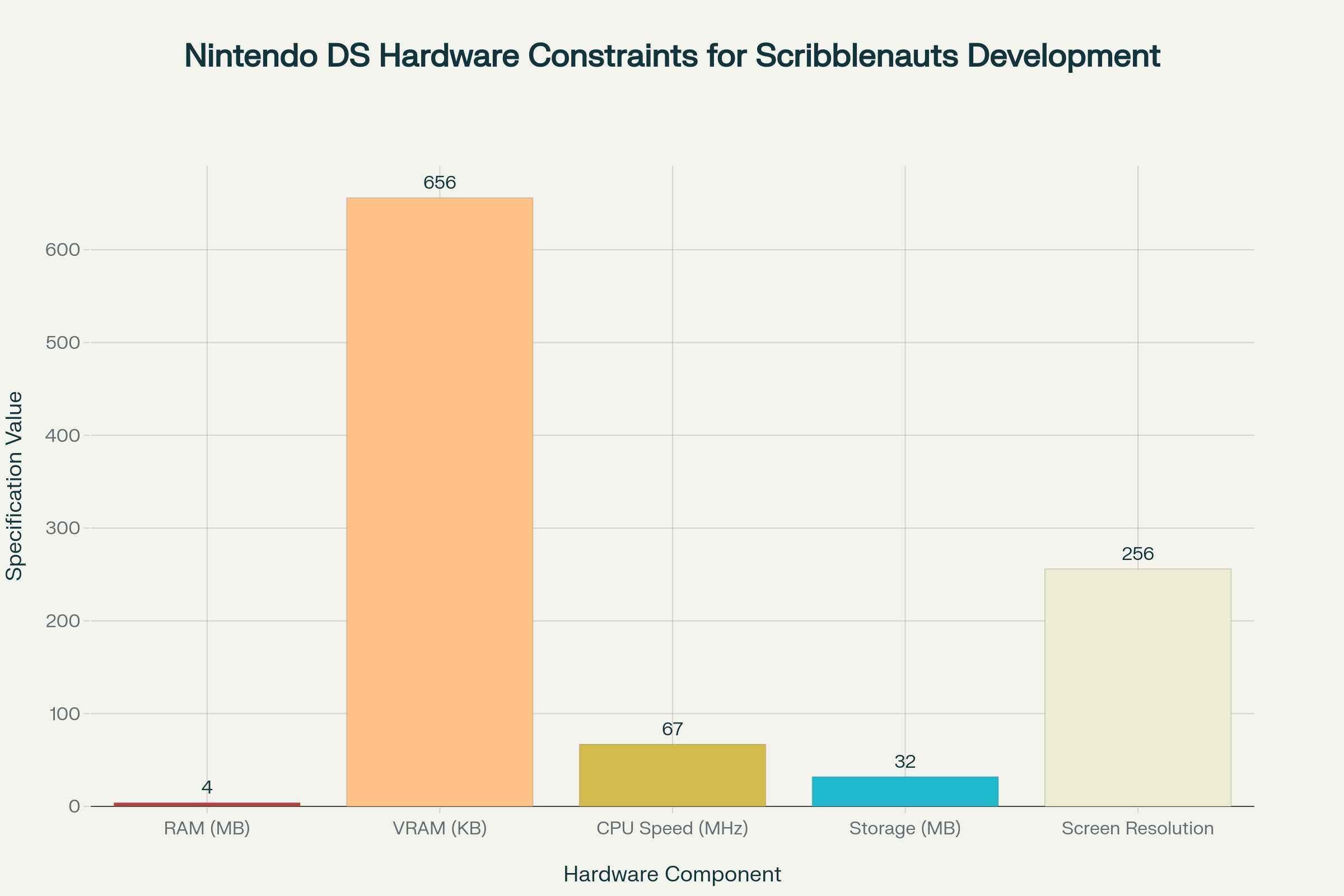
Nintendo DS Hardware Constraints that Shaped Scribblenauts’ Programming Architecture
These constraints forced several critical design decisions:
Memory Management Strategies
- Object Pooling: Critical for the DS’s 4MB RAM limitation
- Palette Swapping: Color variations achieved through pre-baked palettes rather than runtime color manipulation
- Sprite Reuse: Simple art style enabled asset sharing across similar objects
- Flag-Based Logic: Bitmask operations are computationally efficient on low-power CPUs
Input Processing Simplification
The DS hardware necessitated a streamlined parsing approach. Rather than complex natural language processing, Scribblenauts employs:
- Direct string matching against the Objectnaut database
- Alias resolution through simple lookup tables (“auto” → “car”)
- Sequential adjective processing in Super Scribblenauts
- Strict validation - only pre-defined combinations work
DSL Implementation: From Text to Visuals
Input Processing Pipeline
The transformation from user input to visual objects follows this architecture:
- Touchscreen Input Capture: DS stylus input converted to string
- String Parsing & Validation: Exact matching against database entries
- Object Lookup: Database search for matching object template
- Flag Resolution: Application of base properties and adjective modifiers
- Instantiation: Creation of object instance with resolved properties
- Rendering: Sprite selection, palette application, physics initialization
- Behavior Activation: AI state machine and interaction rules applied
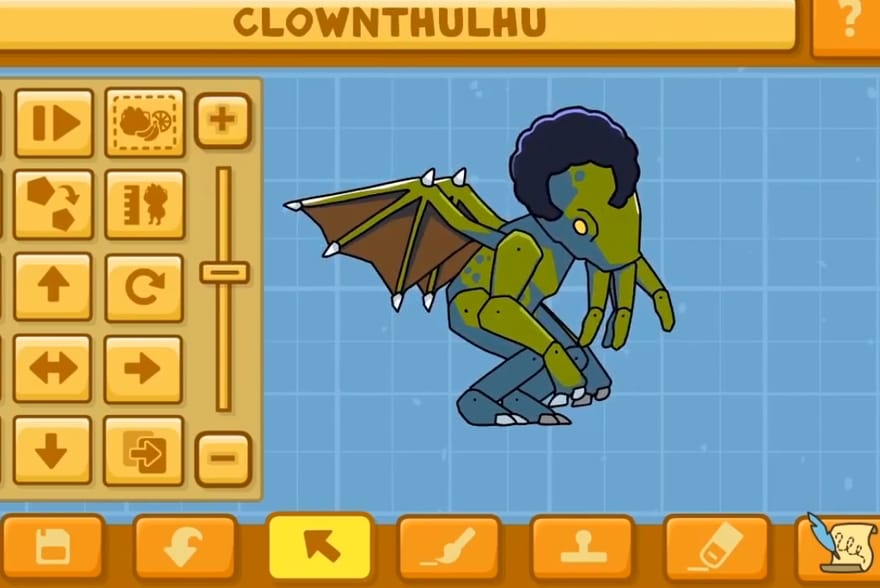
Scribblenauts Objectnaut editor showing a custom character named Clownthulhu with editing controls visible.
Adjective System Architecture
Super Scribblenauts introduced modifier adjectives that transform base objects through flag manipulation:
- Size modifiers: “giant”, “tiny” affect scale and physics properties
- Material modifiers: “metal”, “wooden” change durability and interaction flags
- Behavioral modifiers: “angry”, “friendly” alter AI state machines
- Elemental modifiers: “flaming”, “frozen” add environmental interaction flags

Scribblenauts Unlimited Object Editor interface showing customization of a blue present object.
Comparing Scribblenauts to Other DSLs
Scribblenauts exhibits several characteristics that distinguish it from traditional DSLs:
Unique DSL Properties
- Natural Language Syntax: Unlike HTML tags or SQL queries, accepts plain English
- Immediate Visual Feedback: Output is instantly visual and interactive
- Semantic Flexibility: Multiple valid inputs can achieve similar results
- Domain Constraints: Limited to physical objects and their properties
Limitations as a DSL
Despite its sophistication, Scribblenauts has notable constraints:
- No Procedural Logic: Cannot express complex algorithms or procedures
- Limited Composition: Object combinations are pre-defined, not emergent
- Static Relationships: Interactions follow hard-coded rules rather than dynamic logic
- Vocabulary Boundaries: Effectiveness limited by database completeness
Development Methodology and Team Structure
The creation of Scribblenauts required unprecedented content curation efforts. The development team of approximately 12 people over 13 months spent significant time on non-technical content creation11:
- Word Research: 5 people × 6 months cataloguing vocabulary
- Object Definition: Manual specification of properties for each entry
- Interaction Testing: Verification of flag-based interaction rules
- Art Production: Simple sprites for thousands of objects
- Quality Assurance: Testing object behaviors and interactions
Scribblenauts Unlimited Object Editor interface showing customization of a blue present object.
Technical Innovation Within Constraints
Scribblenauts’ most impressive achievement lies in creating the illusion of unlimited possibility within severe technical and time constraints. The game succeeds as a DSL by:
Smart Abstraction Choices
- Domain Restriction: Limiting scope to physical objects and basic properties
- Simplified Physics: 2D interactions with basic collision detection
- Behavioral Templates: Reusable AI patterns across object categories
- Art Style Efficiency: Simple graphics enabling rapid asset creation
User Experience Design
The DSL succeeds because it maps user expectations to system capabilities. Players naturally think in terms of objects and their properties, which aligns perfectly with the flag-based architecture. The system feels magical precisely because it hides its limitations behind intuitive interaction patterns.
Legacy and Influence
Scribblenauts demonstrates that effective DSLs need not be computationally sophisticated. By carefully choosing domain boundaries and interaction metaphors, the development team created a system that feels far more capable than its underlying implementation suggests.
The game’s approach to natural language processing - essentially a sophisticated lookup table with modifier support - proves that smart curation can often substitute for complex algorithms. This insight has implications for modern AI and natural language processing applications, where similar hybrid approaches combining curated content with algorithmic processing are increasingly common.
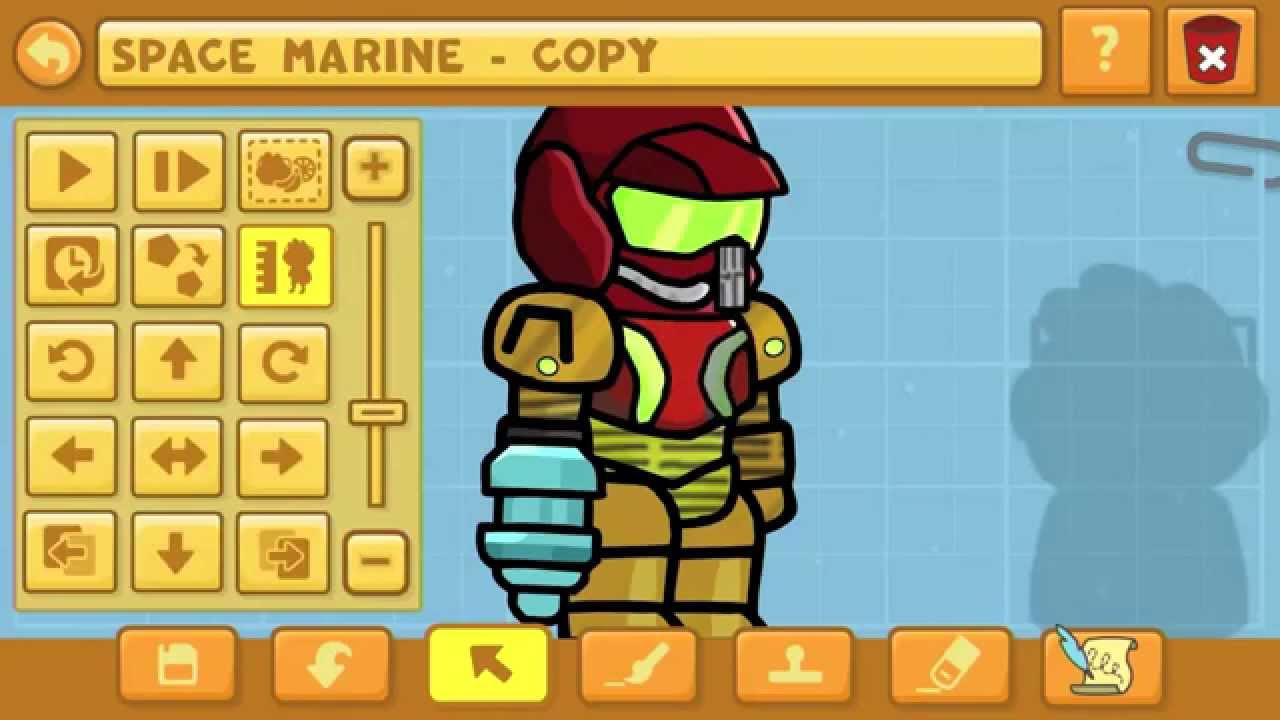
Scribblenauts Unlimited Object Editor showing a custom Space Marine character and editing controls.
Scribblenauts stands as a testament to creative constraint-driven design, proving that the most memorable innovations often emerge from finding elegant solutions to seemingly impossible technical and resource limitations. Its success as a “plain English” DSL comes not from advanced NLP technology, but from meticulous manual craftsmanship disguised behind an intuitive interface.
Footnotes
-
https://www.reddit.com/r/gamedev/comments/b7yi4p/how_does_the_game_scribblenauts_have_tens_of/ ↩ ↩2
-
https://pdfs.semanticscholar.org/9d85/77126445959e01111774cd75f4bbc873b177.pdf ↩
-
https://www.digipen.edu/showcase/news/alumna-helps-ship-super-scribblenauts ↩
-
https://www.eurogamer.net/scribblenauts-dev-making-xbla-game ↩
-
https://www.computerweekly.com/news/252457637/Pure-launches-ObjectEngine-cloud-dedupe-plus-inter-rack-NVMe ↩
-
https://www.polygon.com/2012/11/8/3591160/wii-u-nintendo-changed-scribblenauts ↩